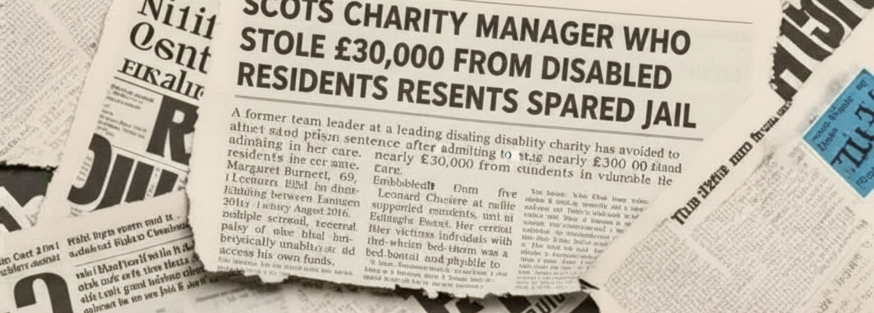
A former team leader at a leading disability charity has avoided a prison sentence after admitting to stealing nearly £30,000 from vulnerable residents in her care.
Margaret Burnett, 69, embezzled £29,900 from five disabled residents at a Leonard Cheshire-supported accommodation unit in Edinburgh between January 2014 and August 2016. Her victims included individuals with cerebral palsy and multiple sclerosis, one of whom was bedbound in a hospital and physically unable to access his funds.
How the Fraud Was Uncovered
Burnett’s actions came to light when bank staff noticed unusual activity on a resident’s account. Leonard Cheshire launched an internal investigation, alerted the authorities, and dismissed Burnett. Police later charged her with fraud in 2019.
Court Proceedings
Burnett pled guilty last month at Edinburgh Sheriff Court. Her lawyer said she developed an online gambling addiction triggered by work-related stress, claiming she initially believed she could repay the money without causing harm.
Sheriff Charles Walls condemned her behaviour as a “gross breach of trust,” noting the offences involved significant planning and targeted individuals who relied on her for care and financial oversight.
Sentence – Burnett was:
- placed on a 12-month supervision order
- given a six-month home curfew from 7 pm to 7 am
- ordered to pay £3,000 compensation to each of the four surviving victims
She has already repaid the full amount stolen to the charity.
Charity and Prosecutor Response
Leonard Cheshire described the theft as a “despicable abuse of trust,” confirming all victims had been reimbursed and that financial controls have since been strengthened with external audit support.
Neil Almond, interim Procurator Fiscal for Lothian and Borders, said Burnett’s actions represented an “egregious betrayal of trust,” adding that financial crimes against vulnerable people will be pursued robustly.
To read the full article, click here